SAFO Statement (Safety Alert for Operators) from the FAA (Federal Aviation Administration) regarding the dynamic rollout of hoist hooks. The FAA has issued SAFO #16015 concerning the possibility of a dynamic rollout (unhooking) with certain models of helicopter hoist hooks. The statement advises operators to: - develop procedures that list the specific D-Ring or other equipment that can be attached to a particular rescue hook where the possibility of D-Ring inversion is physically impossible. - use only rescue hooks that have a mechanical locking system or protections that prevent D-Ring inversion or dynamic rollout. These recommendations, although important, do not guarantee individually and/or combined that dynamic rollout is physically impossible. And here’s why:
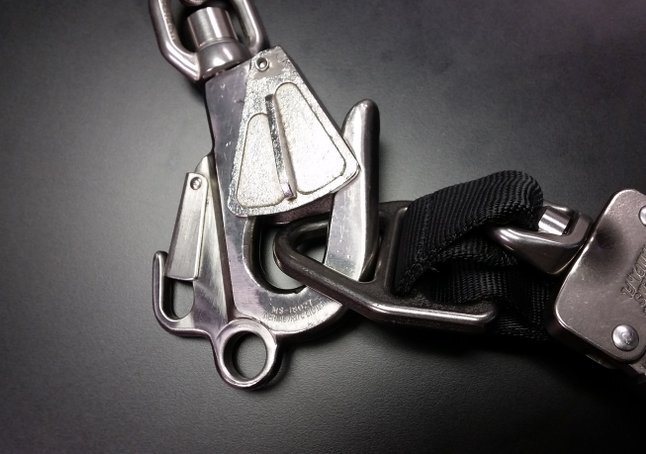
The image above comes from a Canadian Aviation report regarding a 2013 accident in which a dynamic rollout occurred. The hoist hook in that incident met the recommendations of a “hook with mechanical locking system” to prevent rollout. But the problem lies precisely in “what ensures the mechanical lock.” The “pip” pin that should have been activated during the procedure to prevent unhooking is mechanical in nature, very similar to the locking mechanism used in the hoist hook in the next figure.
In both cases, however, locking the hook requires the operator to manually move the lock into the closed or open position. The popular hook in this photo requires the operator to move or activate something. If the requirement is that the operator must move something, then they may risk forgetting that step or inadvertently unlocking the hook in certain operational situations. In LSC’s opinion, what is missing in the FAA recommendation is the term “automatic.” If the hook does not close automatically, then the rollout phenomenon can always occur (in fact, over a sufficiently long timeline, it will certainly occur). Since this type of hook with manual lock and exposed hook tip is susceptible to dynamic rollout, LSC does not recommend, approve, or advise the use of LSC #190 series lifting slings.
Many operator teams use a series of procedures that can be effective in reducing the risk of rollout. However, the operational environment does not care about procedures. The movement of the helicopter and the sea, with the hook dangling between them, can create dynamics that no procedure can fully explain and predict. Teams that use other methods to prevent rollout often trade one risk for another. In fact, if the addition of large rings and carabiners provides alternatives and reduces the phenomenon of dynamic rollout, at the same time it increases the complexity and number of moving parts that could be subject to failure. By far the most reliable way to eliminate the possibility of rollout is to make it physically impossible, using a type of hook that closes automatically so that “hooked” truly corresponds to the “hooked” situation until the operator physically and deliberately performs the unhooking. If you want to know more about these hooks, we recommend the following link